Material Flow Analysis of Discarded Materials
Kansas City Metro Area
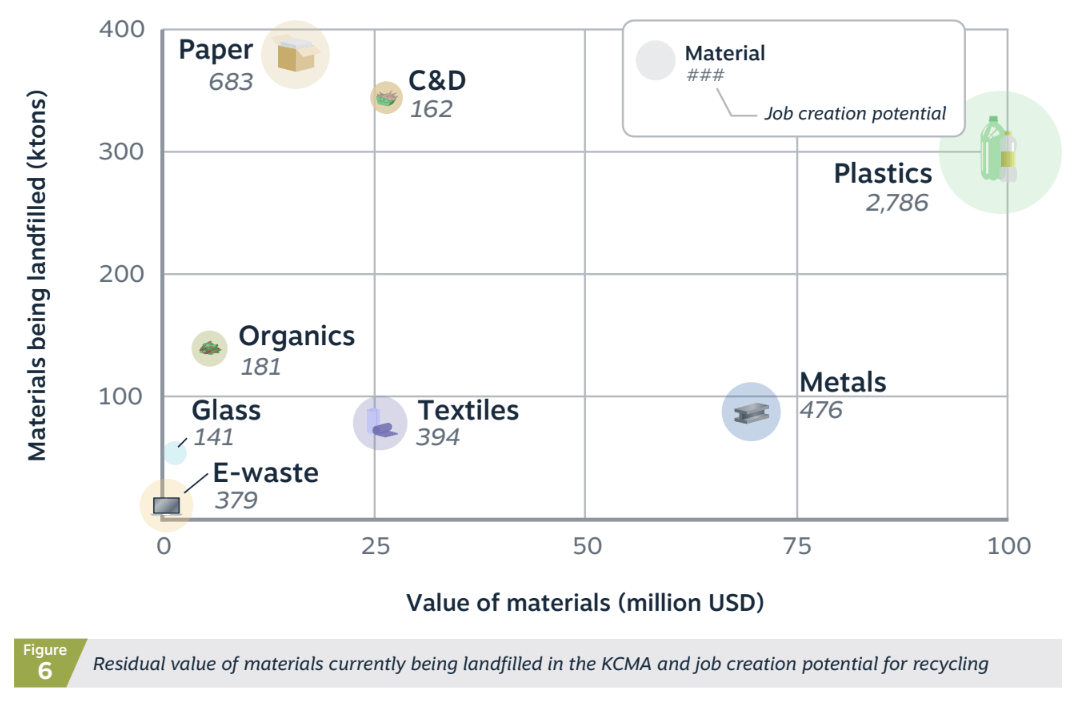
The report reveals that the KC metro area discards 3 million tons annually. 77% that we landfill is valued at $250 million, and if diverted that material into the circular economy it could generate more than 5,000 new jobs and the become the region’s next industry cluster with a market cap in excess of $1 billion.
After identifying the circular economy as a key industry cluster in the Phase I Discovery Report, FFR garnered support from Kansas City Public Works, Johnson County, and MARC to collectively fund a metro area materials flows analysis. The report studied:
- Collection and analysis all available data streams related to waste streams.
- Determine barriers to local progress and understanding of waste embodied carbon.
- Estimate the value of waste streams flowing into landfills and if channeled into circular ventures (i.e., reuse, recycling, etc.), how many jobs that would generate.
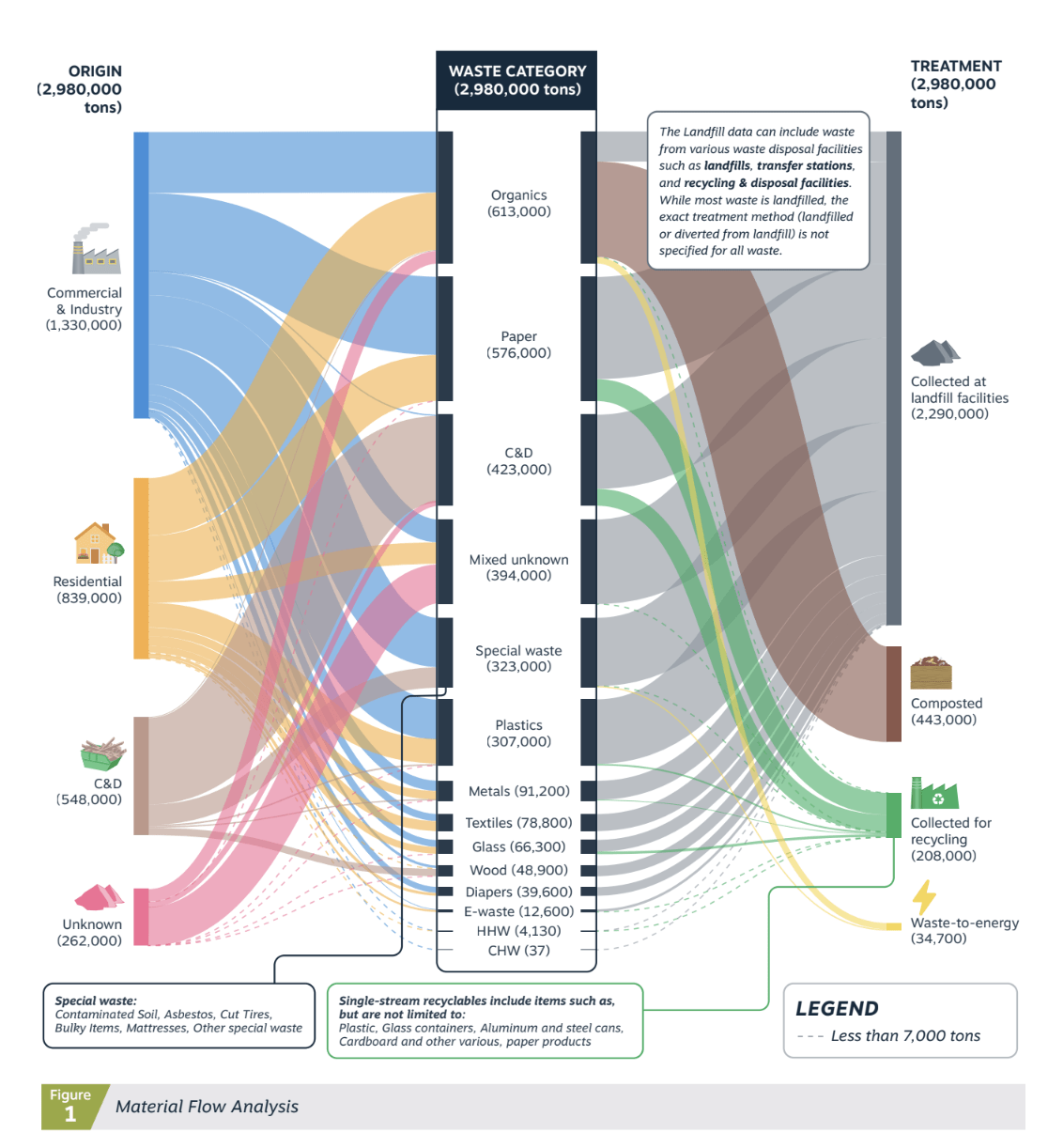
- Develop material flows Sankey diagrams for each principal stakeholder.
- Recommendations on which waste streams are hotspots for expansion opportunities.
- Provided case studies of locations/companies of commercialized implementations.
The project was performed by Darren Beck and Brian Weinberg (FFR) and Jan van‘t Hek, Beatrice Bertolini, Max Läuger and Stijn Louca (Metabolic). The total contract was $100k.
Monumental Opportunity for the KC Region:
“The MFA shows that we are landfilling ~$250 million worth of material each year in the KC region. If we diverted that material into local circular ventures, we could create more than 5,000 new jobs and the region’s next industry cluster with a market cap exceeding $1 billion.” – Brian Weinberg, Managing Director, Foundation for Regeneration
The MFA of Discarded Materials for the KC Metro Area was groundbreaking. It was the first study of its kind to:
- Tally and categorize the amount of waste materials generated within the region
- Quantify the social and environmental impact of that waste by material stream
- Estimate the value of those materials and their potential for local job creation
- Identify the top hotspots for economic growth; plastics, construction and demolition debris, and organic materials
- Share examples of successful circular ventures
Building the Foundation for Growth
- Recycling Infrastructure: Introduced KCMO to Closed Loop Partners → $5.5M secured at 0% interest from The Recycling Partnership to roll out citywide cart-based recycling.
- Circular KC Network: Co-convened 200+ leaders across public, private, and academic sectors. Bequeathed the Circular KC name and assets to launch a regional hub for circular economy leadership in 2025.
- Ongoing Technical Assistance: Advising KCMO’s Office of Environmental Quality on organic waste strategies. Supporting regional ventures with growth planning, business modeling, and ecosystem integration.
Download the Circular Economy Impact Study
The Kansas City Metropolitan Area (KCMA) currently operates predominantly within a linear “take-make-waste” system that results in significant material loss and economic inefficiencies. This Material Flow Analysis (MFA) provides a comprehensive assessment of KCMA’s waste streams, highlighting opportunities to transition towards a circular economy—one that retains resources in productive use, reduces landfill dependency, and creates economic value.